Seeing beyond the file in front of you
A small change can affect code elsewhere in a project. Someone reviewing a function needs to understand its callers, dependencies and place in the wider system, not only the lines immediately around it.
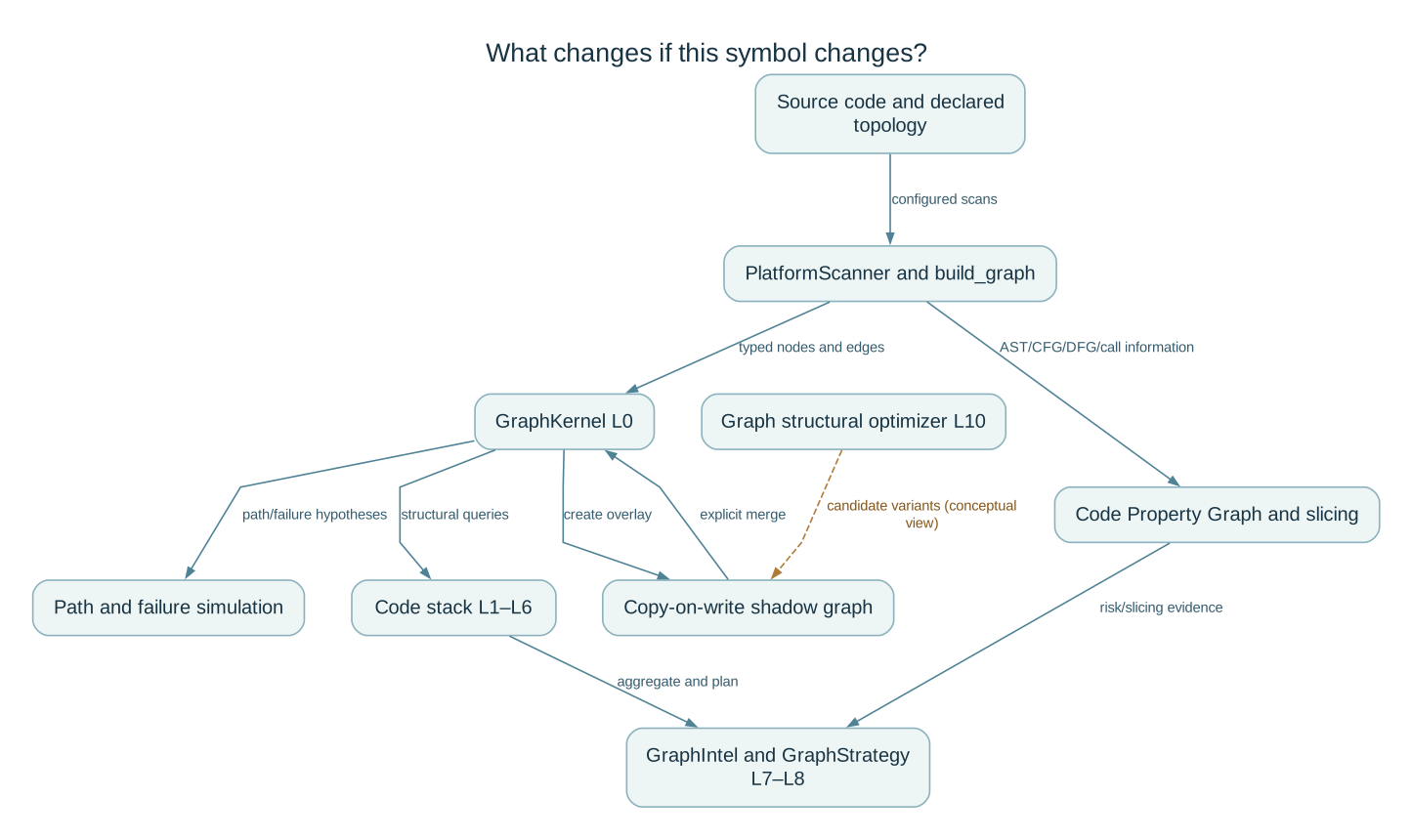
GraFOSa makes those relationships available as structured context. The human purpose is a clearer view of what a proposed change may touch and where closer examination is needed.
What the graph provides
The system builds a static graph of code and exposes tools through the Model Context Protocol, allowing an AI agent to query that structure. Its capabilities include change-impact analysis, potentially unused code, import cycles and ways to divide a codebase into related groups.
Shadow graphs allow a proposed change to be explored on an isolated copy of the graph before that graph change is merged or discarded. This provides a place to examine structural alternatives without treating each proposal as an immediate edit to the working code.
A concrete use
When considering a change to a function, an agent can inspect the relationships around it and identify other parts of the code that deserve review. A person can use the same context to plan tests and decide how widely to investigate.
The graph describes structure. It does not establish every behaviour that will occur when the program runs, so execution and testing remain part of the engineering decision.
Its contribution to collaboration
GraFOSa was architected at Fifth9 as a way to give engineering agents more useful context. It complements memory: one preserves relevant records, while the other describes relationships within the code.
The continuing direction is to make structural information easier to turn into good decisions, with focused questions, understandable answers and evidence of whether the resulting changes behave as intended.