Useful help needs a connected system
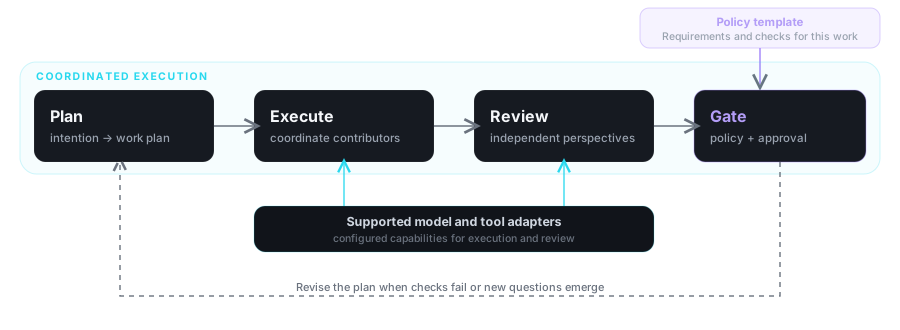
When an intention passes between agents, models and tools, important context can be lost. A useful collaboration needs to retain the purpose, know which capabilities are available and provide a clear account of what happened.
Conduir approaches this as a system architecture. The organism metaphor gives different responsibilities recognisable places: memory, coordination, protection and evolution each have a role in the design.
What has been built
The codebase organises service implementations within a layered architecture. A deterministic work router assigns work to a defined destination. A gateway supports several model providers and refuses requests when the configured requirements cannot be met, rather than silently changing the service level.
A signed constitution defines protected governance, audit and identity boundaries. Agents can propose changes to the system, while tests, review and human approval govern promotion. Memory and review capabilities support the design; bringing the full set into dependable end-to-end journeys remains work in progress.
How improvement is approached
Conduir treats a proposed improvement as something to examine. A change needs evidence that it behaves as intended, and a useful outcome needs more than a persuasive explanation from the model that produced it.
The distinction matters for the wider vision. The ability to propose a change is a step towards evolution; an operating cycle that repeatedly produces useful, governed improvement is a larger goal.
Its place in the journey
Conduir is work architected at Fifth9, following the earlier Maestro platform. It is one contribution to AI Initiative’s wider exploration of human–AI collaboration, with that attribution retained.
The next direction is to connect individual capabilities into meaningful activities people can understand and evaluate: pursuing an objective, retaining its context, checking the result and carrying a useful lesson into subsequent work.