Task definition
Defines what an observation means, which outputs are legal and how an outcome is evaluated.
- Receives
- A task, observations and allowed outcomes
- Produces
- An explicit problem and comparison
 AI Initiative
 lab
Investigate whether intelligence can acquire useful capabilities through smaller, explicitly controlled changes, while preserving the ability to examine what changed.
Research implementation Experimental components and selective-training research. Useful transfer between tasks remains a research question.
The design question
The architecture separates the task’s meaning, the learned proposal and the mechanism that allows an action. That separation makes it possible to ask which change helped, which behaviour stayed useful and where exact computation is a better fit than learning.
A baseline and a candidate face explicit evaluation questions. Selective changes may reuse earlier components, but their value depends on gains, regressions, task context and the total cost of learning and checking.
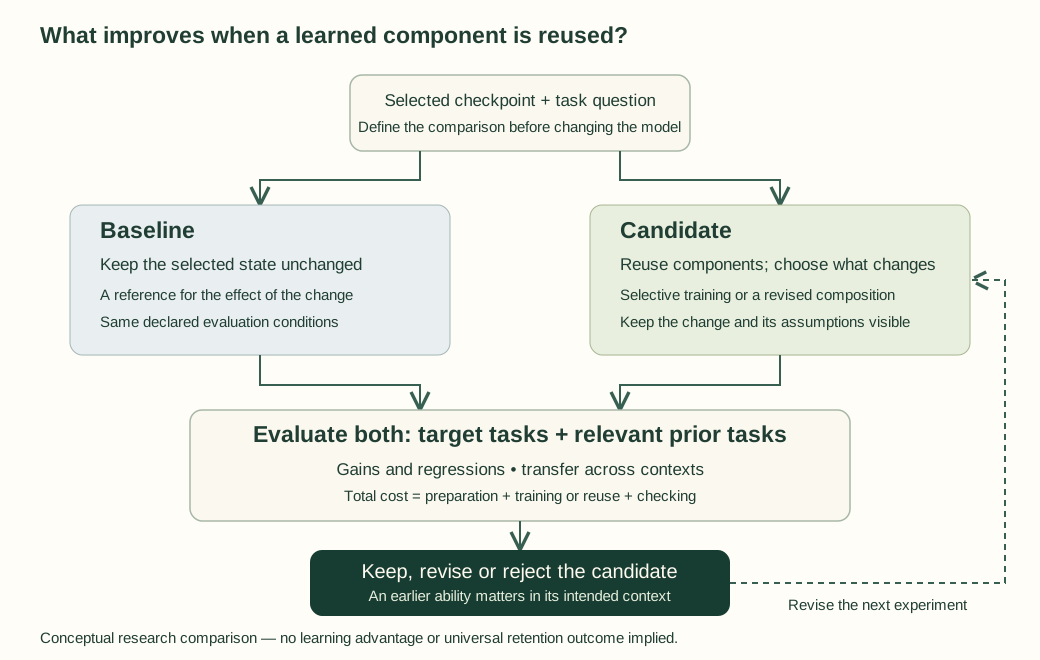
Declare the task and the model state allowed to change, then compare the candidate with its parent and evaluate both target and prior behaviour.
What each part is responsible for
Defines what an observation means, which outputs are legal and how an outcome is evaluated.
Converts a task observation into the representation expected by its model. Model and encoder compatibility are checked together.
Produces a task-specific proposal. Sharing numerical machinery does not make different tasks or checkpoints interchangeable.
The research candidate supports training the output stage while keeping the remaining declared state fixed. Full training remains a separate choice.
Connects an experiment to its starting state, resulting state and evaluation. It supports comparison and recovery rather than treating every change as progress.
Carries proposals between components with explicit meaning. A separate runtime decides whether an action can occur.
Examines the new task, earlier abilities and the combined activity. Preserving parameters alone does not establish preserved behaviour.
Following one piece of work
State what the input represents, what counts as a valid output and how the activity will be assessed. This makes a useful comparison possible: a candidate should be judged on the same problem as its reference, including what information it is allowed to see.
Begin from a known state and declare the part to be trained. The inspected research includes a bounded output-stage update while other declared state remains fixed. This is a controlled experiment, not a general mechanism that can adapt arbitrary learned skills.
Use the defined examples and objective to produce a candidate. Mathematical routines, task validation and model updates have different responsibilities. A reduction in the amount of trainable state is only one part of cost; encoding, data preparation and evaluation still matter.
Compare the resulting state with the declared change scope. Also check the input representation: keeping parameters fixed does not preserve behaviour if the meaning of the inputs changes. Retain the parent so the comparison can be repeated or the candidate rejected.
Examine held-out target behaviour, relevant prior activities and the cost of the complete experiment. Compare against a suitable fresh model or deterministic reference. Keep, revise or reject the candidate according to the result, without treating a successful small example as general transfer.
Illustrative example · not a benchmark result
A new classification activity uses an existing compatible feature representation.
The useful result: A comparison of learning effort, target performance and relevant prior behaviour.
A successful small activity would not establish useful transfer to unrelated tasks or a general reduction in total learning cost.
Learning: Training changes selected model state in response to examples and an objective.
Memory: Experiment records and runtime state preserve context; keeping a record does not retrain the policy.
Exact computation: Arithmetic, input validation, legality and resource accounting can use deterministic code. They do not need to be learned.
Future composition: A general catalogue of named learned skills, arbitrary adaptation and autonomous architecture evolution are wider proposals, not claims about this baseline.
Reading the architecture accurately
Where the design must hold up
| Boundary | Why it matters | How to examine it |
|---|---|---|
| Representation changes | A changed encoder can change behaviour even when model parameters are frozen. | Check the meaning and output of the encoder as well as the declared frozen model state; compare behaviour before and after the change. |
| Checkpoint compatibility | Matching numerical dimensions does not make a checkpoint appropriate for a different task or representation. | Confirm that the task, observation meaning and permitted outputs match; exercise an intentionally incompatible case and require an explicit rejection. |
| Generalisation and retention | A good training score can conceal poor held-out performance or loss of an earlier ability. | Use held-out target cases and relevant prior tasks, with a fair reference and the total cost of the experiment included. |
| Execution trust | The local runtime controls cooperating components; it is not a security sandbox for hostile code. | Demonstrate which local actions are accepted or refused. Evaluate hostile-code containment separately before treating it as a security boundary. |