Exploration brief
Give a discussion a question and boundaries.
- Receives
- A topic, objective and constraints.
- Produces
- A shared question for contributors.
 AI Initiative
Work architected at Fifth9
Manthan separates generating contributions, relating them, preserving their origins and deciding which deserve further attention. Its lineage record is useful even when the quality of an idea remains unsettled. Selecting consistently useful ideas is a separate question from producing many of them.
Idea-lineage research This describes an exploration and knowledge-lineage system, not an authority to execute the ideas it produces.
The design question
Preserve how ideas emerge, challenge one another and develop, so later work can use more than a final summary.
An idea can change through disagreement, combination and refinement. Recording those relationships makes it possible to inspect how a later proposal depends on earlier assumptions, instead of retaining only the final fluent summary.
Different perspectives generate and challenge candidate ideas. Comparison, parent relationships, storage and review keep the path of an enquiry available to the next contributor.
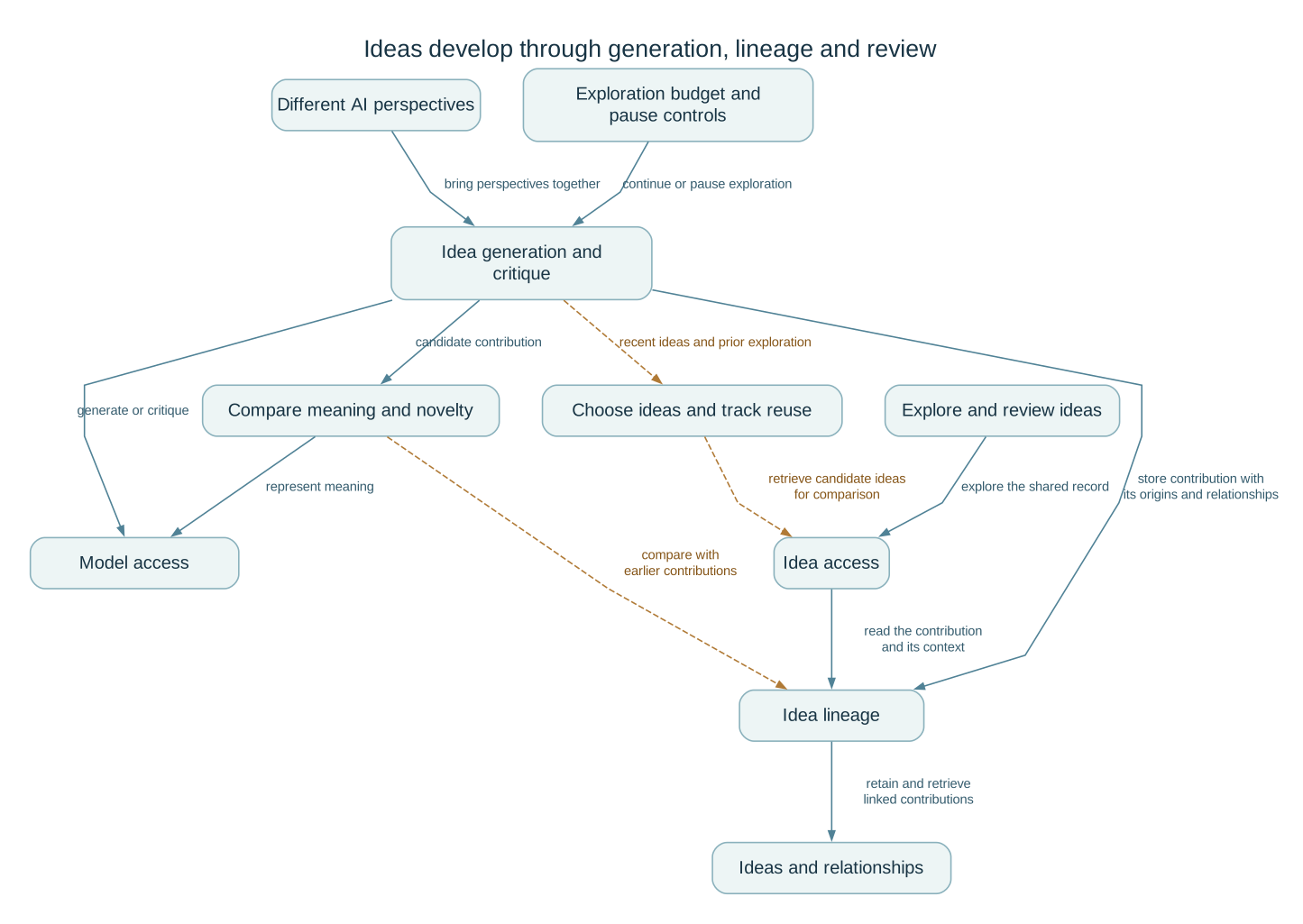
Keep context, responsibility and the boundary between a proposal and an accepted result visible.
What each part is responsible for
Give a discussion a question and boundaries.
Generate and challenge possible approaches.
Record how contributions relate to one another.
Help people inspect the material and decide what deserves attention.
Make selected material available with its context.
Following one piece of work
Choose the decision or exploration the ideas should help with. The brief gives later reviewers a way to distinguish an interesting tangent from a contribution that addresses the actual question.
Invite different approaches to the question while keeping their assumptions visible. A collection of varied wording is not necessarily a collection of genuinely different ideas.
Record how a contribution derives from, refines, contradicts or combines earlier thinking. These relationships make changes inspectable without assuming that the latest version is automatically the best one.
Inspect the contributions rather than equating volume with value. Assess options in relation to the brief and the evidence still needed. A useful output may be a sharper question or a small experiment, rather than a winning proposal declared by the system.
Hand selected ideas to the next stage with their origins, unresolved questions and assumptions. Keeping the reasoning available helps others challenge it without reconstructing the entire discussion.
Illustrative example · not a benchmark result
A team is considering several approaches to a new service.
The useful result: An option to investigate with its origins and uncertainties available.
An illustrative use of idea lineage; it does not assert that automated selection already outperforms human review or a simple baseline.
The record is useful precisely because it can preserve unresolved disagreement. A selection process may choose an experiment to try, but the existence of a lineage or ranking does not prove an idea is true, practical or worth deploying.
Reading the architecture accurately
Where the design must hold up
| Boundary | Why it matters | How to examine it |
|---|---|---|
| Useful thinking | More generated content does not imply more useful thinking. | Compare the usefulness of the resulting options and questions with a simpler exploration process. |
| Lineage versus truth | A recorded lineage preserves origins, not the truth of every claim. | Trace an important claim back to its contributions and examine their assumptions. |
| Permission to act | Ideas and rankings do not themselves authorise deployment or other external action. | Keep the selection of a next experiment separate from permission to carry out consequential action. |