
The question behind the work
Could intelligence organise itself more usefully as its circumstances change? Enigma explores this through model coordination, mathematical descriptions of disagreement and experiments with agent configuration. It also opens questions about emergence, self-understanding and consciousness, without assuming that progress in one establishes the others.
Adaptive organisation asks how a group could change its roles, methods or choice of contributors. Consciousness asks a different question about subjective experience. Better coordination, a convincing answer or a high numerical score does not establish that experience.
From different responses to an examined decision
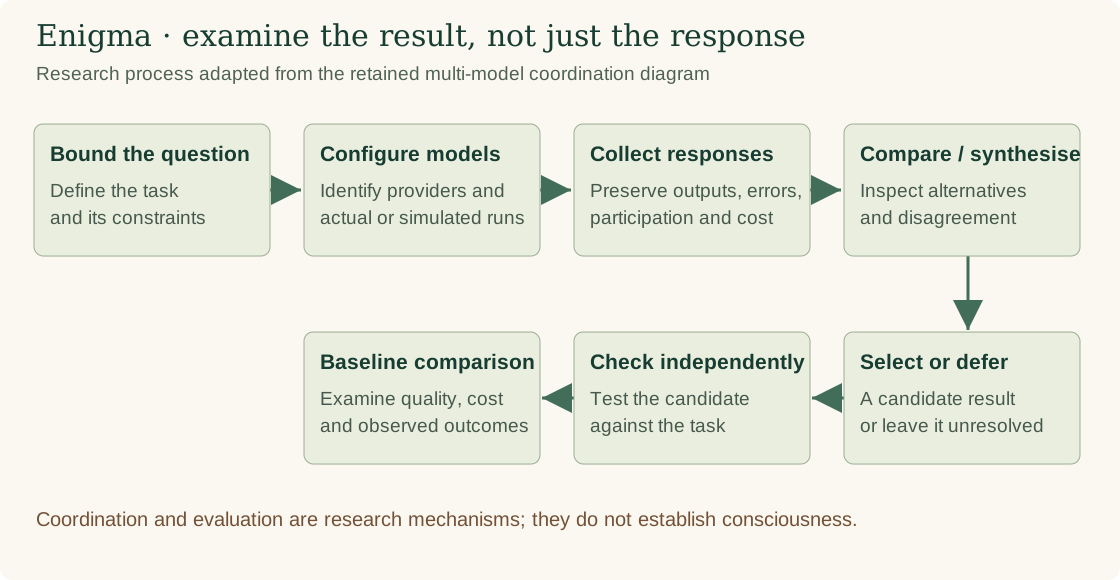
The architecture separates generating an answer from deciding whether it helps. Coordination brings responses from configured models together while retaining failures, time and cost. Comparison examines overlap, alternatives and disagreement. A selection or synthesis step produces a candidate result, or leaves the question unresolved.
Mathematical signals can help describe that process. Entropy summarises how positions are distributed; phase-based measures describe alignment under a chosen representation. Text features provide another diagnostic lens. Each instrument measures a particular input, and its interpretation needs testing against the task.
Agent configuration and lineage offer a way to record different settings, candidate changes and their history. Changing a configuration is distinct from training neural weights. Useful adaptation would require showing that the change improves an appropriate outcome, with its costs and trade-offs included.
Make the comparison visible.
A conceptual research cycle, not a live system view.
- Frame a question
Choose a task and a meaningful baseline.
- Compare responses
Retain alternatives, disagreements and costs.
- Choose or defer
Make a candidate decision; keep uncertainty visible.
- Evaluate outcomes
Check usefulness independently and refine the next experiment.
Use the result to improve the next question and comparison.
Where this could be useful
A research team could compare alternative explanations and identify disagreements worth investigating. A product team could test when several perspectives help a difficult decision and when a simpler method is enough. An evolving system could investigate which model, configuration or combination suits the next task.
These are experimental use cases. The aim is to make collaboration and adaptation inspectable, rather than assume that adding agents or mathematical scores creates better intelligence.
What the work teaches
The retained work spans archived Enigma experiments, standalone prototypes and selected mechanisms carried into Symposium, a coordination layer. These lineages have their own implementation paths, including prototype coordination, reusable configuration models and mathematical helpers. Its strongest lessons concern evaluation. Shared vocabulary is not the same as factual agreement. A measure of diversity does not establish correctness. An apparent alignment can depend on how the inputs were represented.
A useful experiment therefore needs independent task checks and a meaningful baseline. It should retain individual responses, failures and resource costs, repeat comparisons where necessary, and preserve negative results. Reports and attractive charts need a traceable experiment behind them; they cannot supply the missing measurement.
A frontier within the wider vision
Enigma contributes questions and mechanisms to a larger ambition: intelligence that can learn through experience, combine capabilities and reconsider how it works. It is a research lineage with different prototypes and implementation paths, not a single proven consciousness system.
The next step is to ask narrower questions that can be answered: when does coordination improve a result, which signals help choose an approach, and what remains useful in a new setting? Those answers can inform practical systems while the deeper questions remain open.