Quantum RAG Advanced Concepts
Explores complex-valued embeddings, holographic associations, quantum search and richer graph relations, distinguishing representational hypotheses from operation-count scaling.
 AI Initiative
Explores complex-valued embeddings, holographic associations, quantum search and richer graph relations, distinguishing representational hypotheses from operation-count scaling. Defines discovery, technical validation, implementation and version-control agents, orchestration state and human approval gates for a research-to-code workflow.
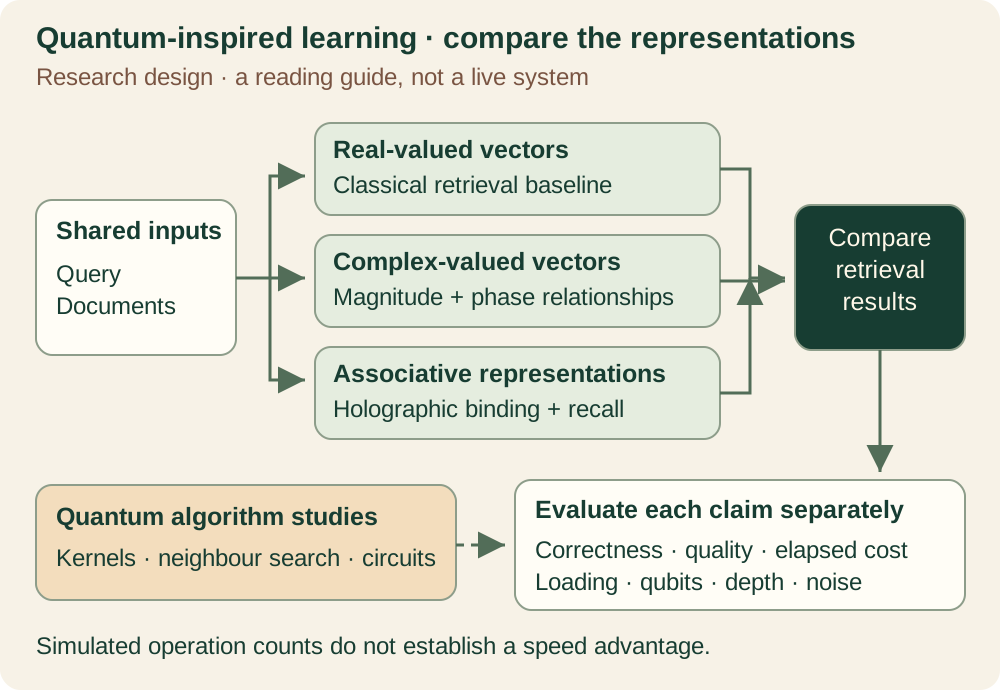
Conceptual research map adapted from the retained quantum RAG guide. Classical vectors, complex representations and associative memory are comparison paths; quantum algorithm studies add separate resource questions. The map is not one implemented pipeline and claims no measured quality gain or quantum speed advantage.
Open the full-size research diagram ↗Original source status and dates remain visible. A research proposal, a technical implementation and an observed result are different parts of the story.
Explores complex-valued embeddings, holographic associations, quantum search and richer graph relations, distinguishing representational hypotheses from operation-count scaling.
Defines discovery, technical validation, implementation and version-control agents, orchestration state and human approval gates for a research-to-code workflow.
Compares seven retrieval methods, QRAM-loading limits, noisy quantum search, complex embeddings, holographic capacity and hybrid paths.
Organizes a large literature search into method-specific validation, challenge, hardware and benchmark questions, proposing a staged empirical program.
Connects a practical small-document personal retrieval system to long-term multimodal memory, with ingestion, provenance, retrieval, validation and resource constraints.
Describes an LSTM error predictor, Kalman drift compensation and rule/neural hardware selection as AI contributions to quantum workload operation.